Jean Monnet European Union Center of Excellence for Populism and Political Economy, 2023-2026
Activities 2023-2026
Volha Charnysh: MIT, November 12, 2026

https://sites.mit.edu/charnysh/
Co-sponsored by European Studies and the Department of Political Science Comparative Politics Colloquium.
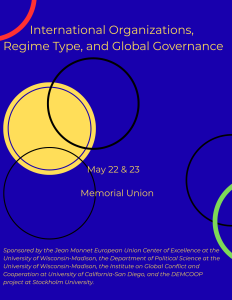
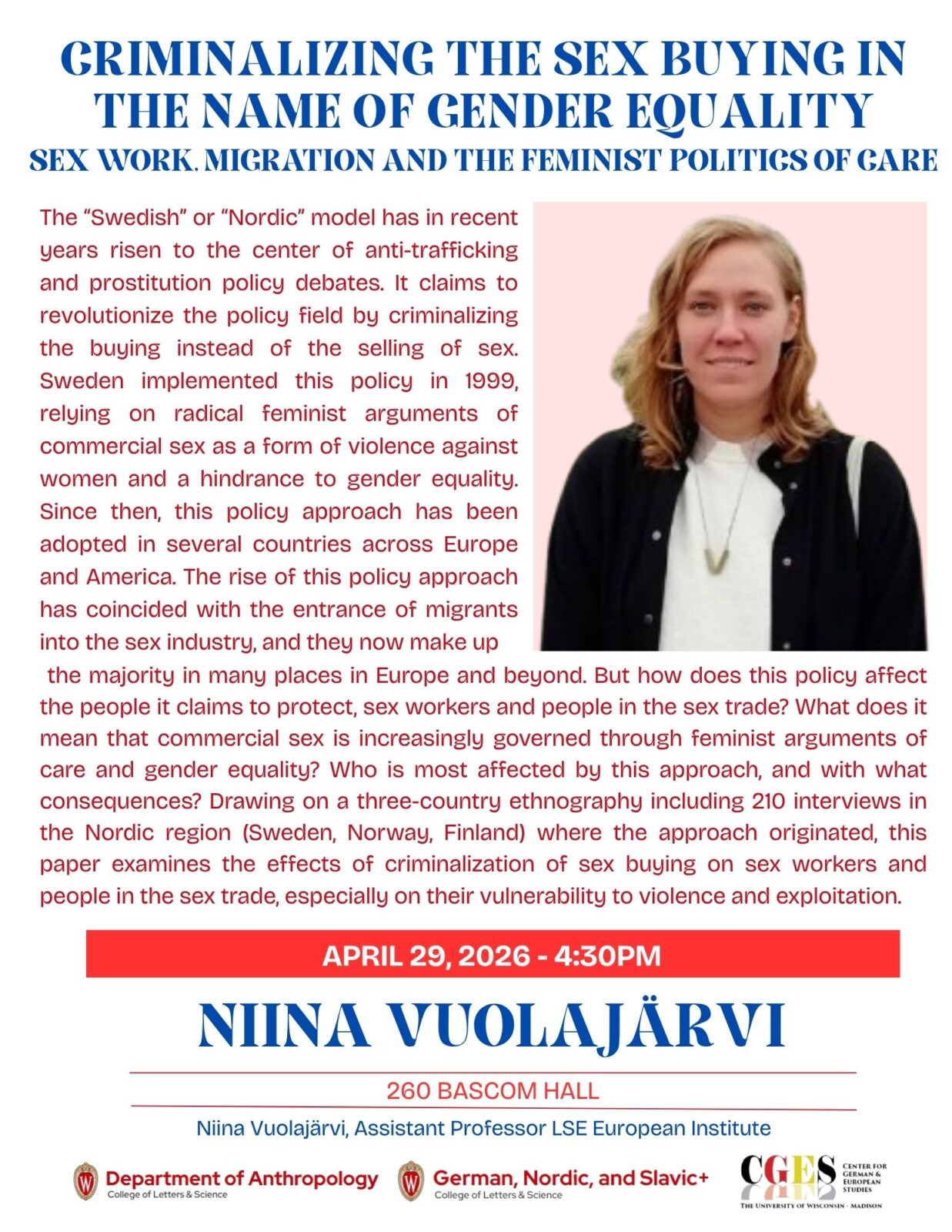
Adrian Treves, “Large Carnivores: Transatlantic Comparisons of Ecology and Policy”
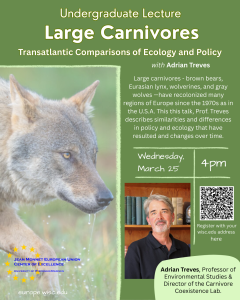
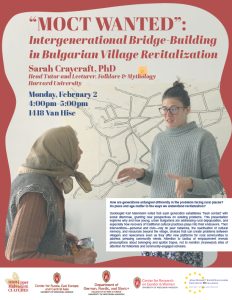
Anna Grzymala-Busse, “Is Autocracy Contagious?”
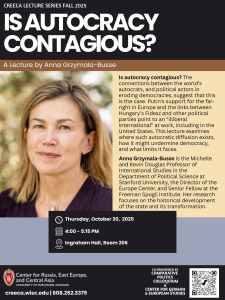
Hanno Hilbig, “Political Debates and the Integration of Ukrainian Refugees in Germany” (October, 23)

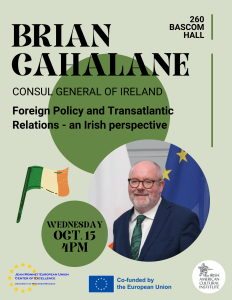
Fabio Ellger, “Who Is the Volk? Rhetorical Cleavages in German Parliamentary Discourse, 1867–1918”
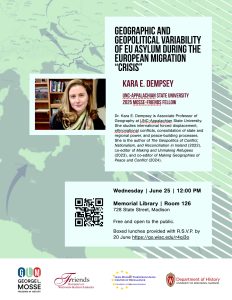
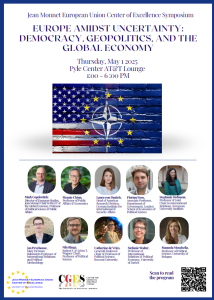
Europe Amidst Uncertainty: Democracy, Geopolitics, and the Global Economy
Florian Foos, “Models, Experiments, and Data”

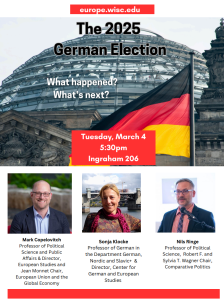
The 2025 German Election: What Happened? What’s Next?
Johannes von Moltke, Prophets of Deceit: Genealogies of Agitation and the Critical Theory of “Metapolitics” – (Recording of Lecture 3)
Johannes von Moltke, The Identitarian Reflex: “Metapolitical” Strategies of Appropriation and Projection – (Recording of Lecture 2)
Johannes von Moltke, Making the World Glow: Right-Wing “Metapolitics” and the Accelerationist Impulse – (Recording of Lecture 1)

Fatma Aydemir, “Djinns: A Reading and Conversation with Fatma Aydemir and Jon Cho-Polizzi”

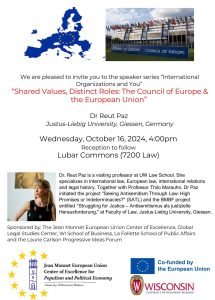
Reut Paz, “Shared Values, Distinct Roles” The Council of Europe & the European Union”
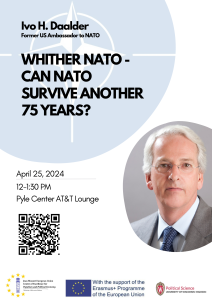
Ivo H. Daalder, “Wither NATO – Can NATO Survive Another 75 Years?”
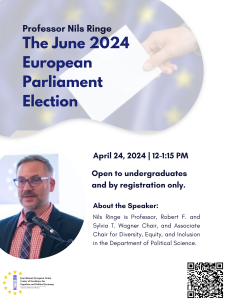
Nils Ringe, “European Parliament Election in June 2024”
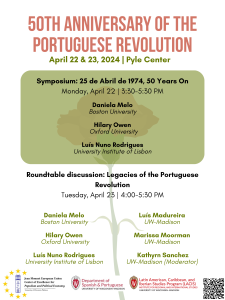
50th Anniversary of the Portuguese Revolution (Remembering April 25, 1974)
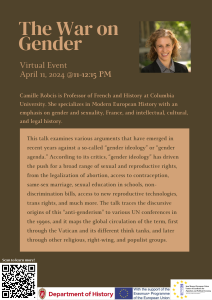
Camille Robcis, “The War on Gender”
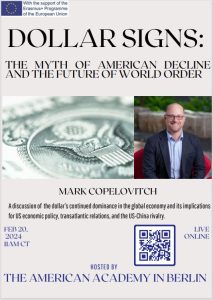
Mark Copelovitch, “Dollar Signs: The Myth of American Decline and the Future of World Order”
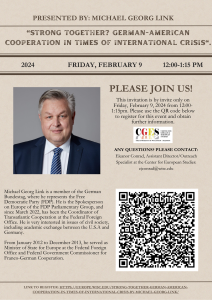
Michael Georg Link, “Strong Together? German-American Cooperation in times of International Crisis”
The University of Wisconsin–Madison has a long and proud tradition of multidisciplinary research and teaching on the European Union. In 2023-2026, the Wisconsin Jean Monnet Center of Excellence for Populism and Political Economy under the leadership of Professor Mark Copelovitch will continue its research on domestic politics in Member States, international organizations, and the European Union, with a strong focus on international political economy. Scholars in both economics and political science have long studied the EU and its economic policies and crises. Yet the role of the EU as a major actor in international organizations, and the ways in which politics within the EU and the EU-27 shape the politics of global economic governance and cooperation (and conflict) between the EU, U.S., China, and other “great powers,” remain under-explored topics in both fields.
Since 2008, the global economy has been shaken by a series of major challenges, including the Global Financial Crisis, the Eurozone crisis, Brexit, the COVID-19 pandemic, populist crises and the Russian war in Ukraine, all challenges to the established order. In each of these, the European Union and its member-states have featured prominently. In fact, these crises and policy responses to them have become defining features of national, European, and international politics, in which the EU and the EU-27 have been central players. As the EU will be one of the most important actors in global economic governance and crisis management throughout the remainder of the 21st century, understanding the politics and economics driving EU policy choices and the behavior of its leaders, institutions, and member-states in the world economy is a crucial subject of research and inquiry in the years ahead.
The Center’s new Wisconsin-based affiliated scholars have competencies which will contribute to global knowledge on the EU. Three teams explore, teach, research, present and publish on these core fields of inquiry, including 1) The Eurozone and the global economy; 2) Crises, shocks, and European politics; and 3) Populism and party system change in Europe. In addition to their research agenda, these scholars will conduct the wide-ranging outreach required of the as international faculty, counselling students, local governments, EU and U.S. citizens on the inner and global workings of the European Union. Three teams will explore teach, research, present and publish on, 1) The Eurozone and the global economy (Copelovitch, Chamedes, Chinn, Pevehouse); 2) Crises, shocks, and European politics (Copelovitch, Barnes, Covington, Lo, Schulte); and 3) Populism and party system change in Europe (Ringe, Schulte, Copelovitch and Wagner). This multidisciplinary team of scholars ranges from academic staff to new assistant professor to senior (full professor) faculty with specialized knowledge on the European Union.
In this latest era of economic and political crisis, it is imperative that the scholarly community in the U.S., the EU, and beyond continue to develop new tools to analyze, understand, explain, and teach about the EU and its role in the global economy and global governance. The Wisconsin Jean Monnet European Union Center of Populism and Political Economy will renew its legacy of excellence in EU teaching and conduct high-quality research, teach, mentor, and collaborate in such activities.
Adeline Lo – Assistant Professor in Political Science
Professor Lo will contribute towards researching crises, shocks, and European politics.
Elizabeth Covington – Teaching Faculty IV
Dr. Covington is developing a set of courses to accompany a Jean Monnet project on global reassessment of the “transatlantic” agenda.
Giulianna Chamedes – Associate Professor of History
Professor Chamedes is developing historical work on Europeanbased international organizations developing in conjunction with the EU since 1957 and comparative longitudinal studies of “austerity” policy.
Jon Pevehouse – Professor in Political Science
Professor Pevehouse will continue to work on democracy and corruption in international organizations.
Mariel Barnes – Assistant Professor of Public Policy
Professor Barnes works on comparative U.S. and EU prevention of gendered violence through policymaking.
Mark Copelovitch – Jean Monnet Chair in the European Union and the Global Economy
Wisconsin Center of Excellence Director Mark Copelovitch will continue his planned research on the role of the EU and its component institutions (the Commission, the European Central Bank) as key actors in global economic governance and major international economic organizations (the International Monetary Fund, World Trade Organization, World Bank, regional development banks, the Bank for International Settlements, G-20, Basel Committee, etc.). This will include analysis of the politics and economics of international trade, monetary, and financial relations between the EU and the US, China, and other leading countries in the global economy. As a current Jean Monnet Chair, Professor Copelovitch is well situated to lead a multi-disciplinary team studying these topics.
Menzie Chinn – Professor of Economics
Professor Chinn will continue global work on the EU’s part in international political competition, focusing on the economic effects of the Ukraine conflict.
Michael Wagner – Professor in Journalism and Mass Communication
Professor Wagner will engage in research relating to populism and party system change in Europe.
Nils Ringe – Robert F. & Sylvia T. Wagner Chair and Former Jean Monnet Chair
The proposed center will build on the rich work done during 2019-2022 by Professor Nils Ringe continuing his work on comparative politics and populism. Building upon the success of his edited 2023 Routledge volume Populists and the Pandemic, developed through Jean Monnet 2019-2022 work on populism in global perspective, Professor Ringe’s next major project will focus on national party system change within the EU. This co-authored project, with Dr. Sanja Badanjak (University of Edinburgh), investigates the impact of EU membership on national party systems, about which relatively little is known despite the recent politicization of “the EU” in domestic politics. Invited speakers will display expertise on how EU membership and existing national institutions structure party competition, including the emergence and success of radical, populist, eurosceptic, and anti-system parties.