- How do migrants react when their new home country experiences major changes toward immigration?
- How can European migrants suffer from changes to their legal status over time in their host country (from asylum seeker or refugee to migrant, for example?)
- How did 1950’s supranational groups like the United Nations coin the notion of the Great Refugee Problem?
These are only a few of the queries five invited scholars and three UW-Madison organizers examined in a recent workshop, “Migration and Memory in Postwar and Contemporary Europe.”
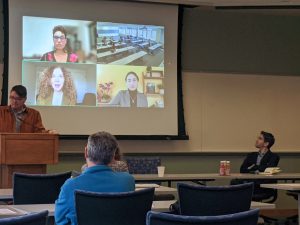 On November 15, 2025, Assistant Professors Brandon Bloch (History), Liina-Ly Roos (German, Nordic & Slavic+) and Leonie Schulte (Anthropology, German, Nordic & Slavic+) brought their working group together for the day. They explored how today’s migration policies can change, if not challenge, European discourses over historical memory, and how immigrants can resist dominant cultural narratives and stereotypes within their host country.
Throughout the day, scholars engaged with subjects as diverse as the Vietnamese migration to Germany in the 1970’s to Finnish views on stereotypes of “Russian” women which contain dated colonial imagery, the significance of visibility activism in Swedish film in confronting the erasure of racial identity as part of its national liberal identity, and the incorporation of aspects of Holocaust memory into current struggles over migration policy in Germany. The audience of faculty, students, and members of the public, was able to participate in lively discussion with the speakers at the end of each panel.
This working group contains individuals in six different disciplines from six separate institutions. They will publish a special issue concerning the topic of this workshop in a journal within short order.
The organizers, Bloch, Roos and Schulte are to be commended for the dynamism of their group efforts, and the importance of this cutting-edge scholarship. For a full list of participants, please see the European Studies website: https://europe.wisc.edu/event/migration-and-memory/. This workshop was made possible through a grant from the German Academic Exchange Service (DAAD) with additional support the Department of History; the Department of German, Nordic, and Slavic+; and the Department of Anthropology.