Co-Sponsored by European Studies, the George L. Mosse Program in History, University of Wisconsin-Madison Department of History, and with the support of the Cultural Services of the Embassy of France in the United States through the Center for Interdisciplinary French Studies at the University of Wisconsin-Madison.
Catherine Tatiana Dunlop will discuss her recent publication “The Mistral: A Windswept History of Modern France.”
The Mistral: A Windswept History of Modern France : An in-depth look at the hidden power of the mistral wind and its effect on modern French history.
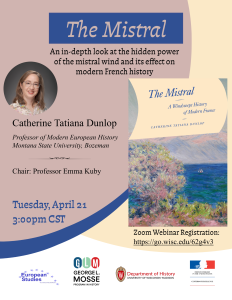 Every year, the chilly mistral wind blows through the Rhône valley of southern France, across the Camargue wetlands, and into the Mediterranean Sea. Most forceful when winter turns to spring, the wind knocks over trees, sweeps trains off their tracks, and destroys crops. Yet the mistral turns the sky clear and blue, as it often appears in depictions of Provence. The legendary wind is central to the area’s regional identity and has inspired artists and writers near and far for centuries.
This force of nature is the focus of Catherine Dunlop’s The Mistral, a wonderfully written examination of the power of the mistral wind, and in particular, the ways it challenged central tenets of nineteenth-century European society: order, mastery, and predictability. As Dunlop shows, while the modernizing state sought liberation from environmental realities through scientific advances, land modification, and other technological solutions, the wind blew on, literally crushing attempts at control, and becoming increasingly integral to regional feelings of place and community.
 Dr. Catherine Tatiana Dunlop is Professor in the Department of History and Philosophy at Montana State University. Her research explores historical conflicts over the meaning and use of natural landscapes in modern Europe. Her first book, Cartophilia, examined the role of mapmakers in the French-German border dispute over Alsace-Lorraine. Her second book, The Mistral, focused on the environmental history of Provence’s violent and uncontrollable mistral wind. The Mistral was awarded the J. Russell Major Prize in French History and the George L. Mosse Prize in European Intellectual and Cultural History from the American Historical Association in 2025. She is currently at work on a new research project that investigates the role of environmental knowledge in the planning, execution, and aftermath of the D-Day landings in Normandy.